AQUATIC ANIMALS · ENVIRONMENTAL HEALTH
Aquatic animal wellness
begins with the water.
A practical owner guide to aquariums and ponds: water quality, filtration, nutrition, quarantine, routine monitoring, veterinary care and warning signs in ornamental fish.
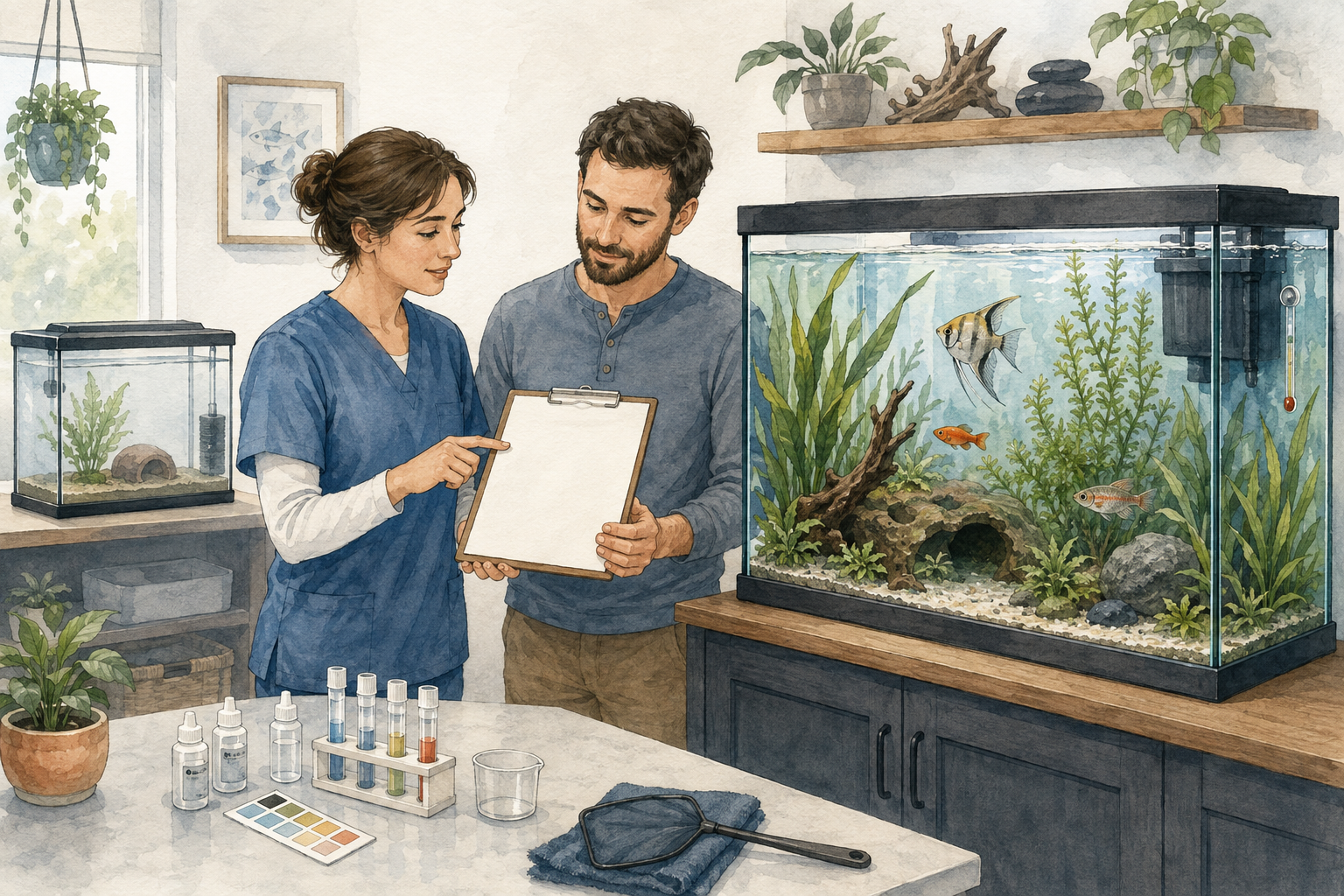
SPECIES AND SYSTEM FIRST
A healthy aquarium is a living system—not a container of clean-looking water.
Fish depend on stable temperature, oxygen, pH, salinity when applicable and biological filtration. Clear water can still contain toxic ammonia or nitrite, so appearance and odor cannot replace testing.
Choose animals by adult needs—not store location
| System | Common companion examples | Planning issue |
|---|---|---|
| Freshwater tropical | Betta, guppy, platy, molly, tetra, rasbora, gourami, corydoras and freshwater angelfish | Temperature, shoal size, fin-nipping, water chemistry, flow and adult bioload. |
| Cool-water freshwater | Goldfish, weather loach and some minnows where legal | High oxygen and waste production; goldfish require far more space and filtration than a bowl. |
| Large or long-lived freshwater | Koi, plecostomus, oscar, discus and some catfish or cichlids | Adult size, lifespan, aggression, diet, pond depth or very large systems. |
| Marine fish | Clownfish, gobies, blennies, cardinalfish, tangs and wrasses | Stable salinity, mature filtration, territory and collection ethics. |
| Aquatic invertebrates | Freshwater shrimp and snails; marine corals, shrimp, crabs and mollusks | Copper and many medications can be lethal; salinity, minerals, feeding and legal sourcing differ. |
| Specialists | Seahorses, rays, eels, puffers and brackish-water species | Advanced feeding, system design, toxin, handling and veterinary requirements. |
Write down what the animals actually live in
- Identify every species and its adult size, temperature range, social needs, diet and freshwater, brackish or marine requirements.
- Record the true water volume after substrate and decor, filter type, heater or chiller, aeration, lighting and maintenance schedule.
- Confirm that tank size, swimming space, current, hiding areas and group size fit the species—not merely the fish's current juvenile size.
- Use reliable thermometers and alarms where equipment failure could cause rapid harm.
- For ponds, plan for seasonal temperature, depth, oxygen, runoff, predators and power outages.
Test numbers and trends—not only whether the water looks clear
| Measure | What it tells you | Owner response |
|---|---|---|
| Temperature | Controls metabolism, oxygen demand and immune function. | Compare with the species range and correct changes gradually unless a veterinarian directs otherwise. |
| Ammonia | Waste is exceeding biological filtration or the filter is not established. | Treat as urgent husbandry information; protect oxygenation, verify the result and seek species-specific advice. |
| Nitrite | The biological filter is incomplete, disrupted or overloaded. | Test ammonia too, review stocking and filter history and avoid adding animals. |
| Nitrate | Shows accumulating end products and helps guide maintenance. | Use planned partial water changes and system-specific targets; a sudden large correction can destabilize sensitive animals. |
| pH and alkalinity | Describe acidity and buffering stability. | Investigate a changing trend; do not rapidly chase a generic pH number. |
| Salinity | Essential context in marine and brackish systems. | Measure with an appropriate calibrated instrument and match changes carefully. |
| Dissolved oxygen | May fall with heat, crowding, organic waste or equipment failure. | Surface-gasping or a group breathing rapidly requires immediate attention to aeration and professional advice. |
A new tank needs time to become biologically ready
Fish release ammonia through their gills and waste. Beneficial microorganisms in the biological filter convert ammonia to nitrite and then nitrate. A new, over-cleaned, medicated, overcrowded or failed system may lose this protection.
- Cycle and test a new system before fully stocking it; adding many animals at once can overwhelm developing filtration.
- Keep filter media wet and oxygenated during maintenance or power interruption.
- Do not replace all filter media or scrub the entire system at once unless a qualified professional has given a specific reason.
- Rinse reusable biological media as directed, usually with removed system water rather than untreated chlorinated water.
- Match water-change temperature, salinity and conditioning to the system and avoid abrupt full-tank changes.
- Keep a battery aerator and outage plan for systems that cannot safely remain without circulation.
Five quiet minutes can reveal a problem early
- Before feeding, observe swimming, balance, breathing rate, position in the water, social behavior and response to you.
- Confirm that filters, pumps, air stones, heaters, chillers, lights and automatic top-off equipment are functioning.
- Count animals when practical and look for uneaten food, waste accumulation, damaged fins, spots, swelling or color change.
- Remove deceased animals promptly with dedicated equipment and call before discarding one if diagnostic testing may be useful.
- Log test results, water changes, new additions, appetite, treatments and equipment changes so trends are visible.
- Clean algae and substrate in a planned way without stripping the biological filter or exposing animals to cleaner residue.
Feed for the species and watch every animal eat
- Use a nutritionally complete food appropriate to whether the species eats at the surface, midwater, bottom or by grazing.
- Match food size and texture to the mouth and feeding behavior; variety does not compensate for an unbalanced staple diet.
- Offer only what the animals can consume appropriately and remove excess before it degrades water quality.
- Watch timid, nocturnal and bottom-dwelling animals separately so dominant fish do not receive the entire ration.
- Research adult size and total biological load before purchase; a small fish can become a large waste producer.
- Do not feed wild-caught prey or introduce untreated plants, rocks or water from natural waterways because they may carry contaminants or disease.
Protect the established aquarium from new arrivals
- Use a physically separate quarantine system for new fish for at least 30 days; longer may be appropriate for the species, source or disease risk.
- Give quarantine its own net, siphon, buckets, test equipment and towels, and care for the established collection first.
- Observe appetite, respiration, swimming, feces, skin, fins and gills rather than automatically giving a mixture of medications.
- Quarantine plants and invertebrates according to risks appropriate to the collection.
- Do not move water, filter media, decor or animals from quarantine into the display system without a plan.
- Never release aquarium animals, plants or water into storm drains or natural waterways; use local surrender or disposal guidance.
Stabilize information before reaching for a bottle
| Pattern | Possible significance | What to do now |
|---|---|---|
| Several species affected suddenly | Oxygen, temperature, toxin, power or water-quality problem | Check equipment and water immediately; increase safe aeration and call for guidance. |
| One fish affected | Injury, individual disease, bullying or an early outbreak | Observe the group, document signs and prepare a separate hospital system if advised. |
| Gasping or very rapid gill movement | Low oxygen, gill injury, ammonia or nitrite exposure, infection or toxin | Treat as urgent; do not assume it is simply stress. |
| White spots, excess mucus or flashing | Parasites, irritation or water-quality injury can look similar | Photograph or video, test water and seek diagnosis before treatment. |
| Bloating, abnormal buoyancy or erratic swimming | Dietary, environmental, infectious, neurologic or internal disease | Limit handling and obtain aquatic veterinary guidance. |
| Ulcers, bleeding or rapidly deteriorating fins | Trauma, infection, parasites or environmental injury | Prompt examination is needed; preserve water-quality records. |
Aquatic veterinarians can examine, image, sample and treat fish
- Establish an aquatic-experienced veterinarian before a valuable fish or whole collection becomes ill.
- When calling, provide species, number affected, system volume, stocking history, recent additions, test results, temperature, diet, equipment and every product already used.
- Ask how to collect a separate water sample; the veterinarian may request both system water and a representative live fish.
- Do not feed immediately before transport unless instructed. Use a sturdy fish bag or safe lidded container with adequate water and oxygen, protected from temperature extremes.
- Transport water for testing in a separate clean container rather than relying only on the water holding the fish.
- A freshly deceased fish may retain diagnostic value if handled exactly as the veterinary team directs; call before freezing or discarding it.
TRUSTED SOURCES
Sources behind this guide
Source links are provided so readers can review the underlying guidance. Publication dates and recommendations can change; confirm individual plans with the treating veterinary team.