PARASITE LIBRARY · FLEAS
Household fleas
are not loyal to their name.
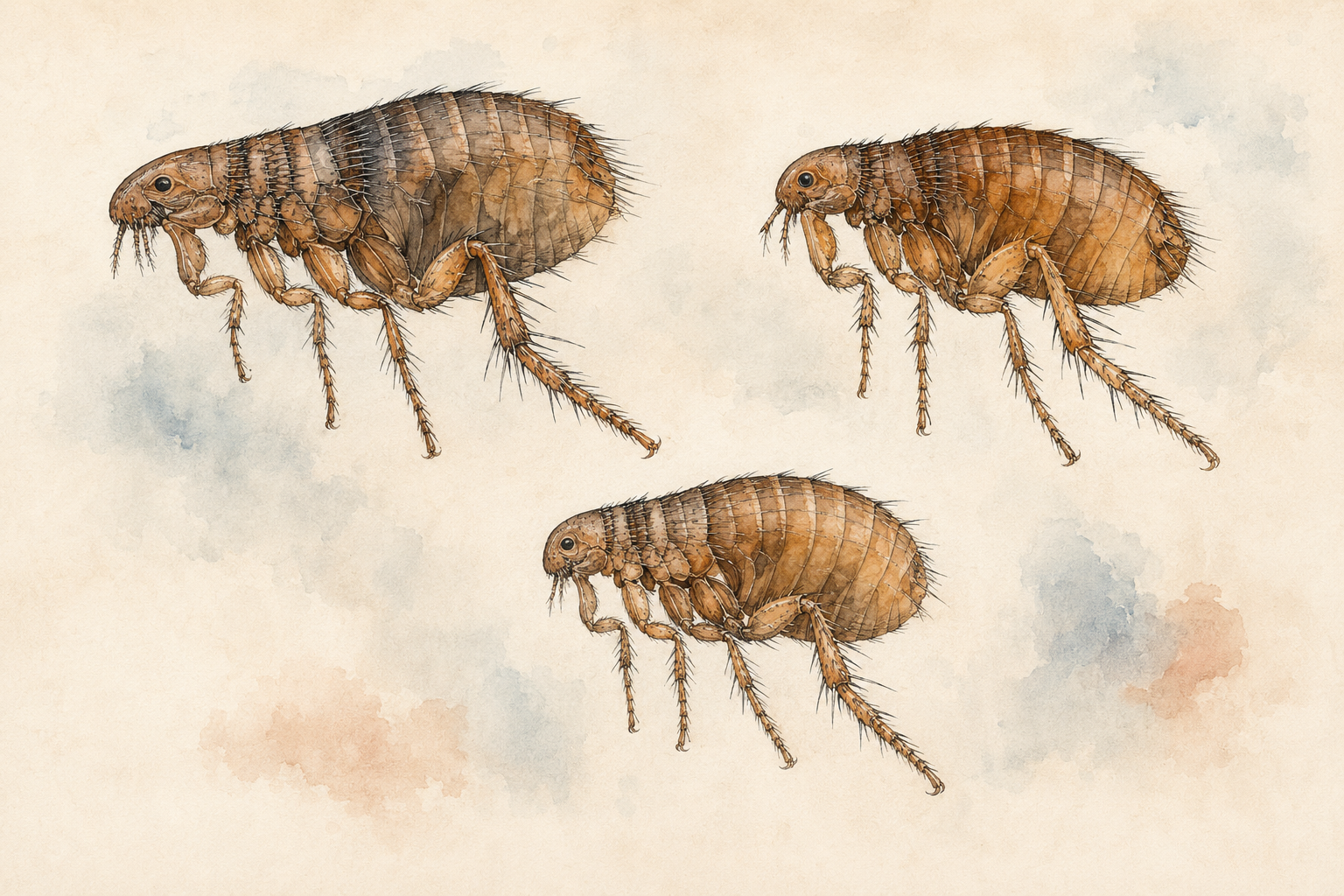
Cat fleas, dog fleas and human fleas can use more than one host. Learn which species is most common, how infestations persist and why every animal and the environment must be considered.
IN THIS GUIDENames do not define a single hostMost of the infestation is not on the petOne flea can matter to an allergic animalTreat every suitable host on the same timelineFleas can affect animals and peopleGet help before skin disease or anemia becomes severeTrusted sources
THREE NAMES · OVERLAPPING HOSTS
Finding fleas on a dog does not prove they are dog fleas.
In North America, Ctenocephalides felis—the cat flea—is the most common flea on both cats and dogs. Ctenocephalides canis and Pulex irritans occur, but visual confirmation by a trained professional is needed to identify species reliably.
C. felisusually dominates homes3 stagesdevelop off the animalAll petsmust be included in control
01 · THE THREE SPECIES
Names do not define a single host
| Common name | Scientific name | What owners should know |
|---|---|---|
| Cat flea | Ctenocephalides felis | Most common flea of cats and dogs in North America; can bite people and infest other mammals. |
| Dog flea | Ctenocephalides canis | More strongly associated with domestic and wild canids but can use other hosts; less common than the cat flea in many U.S. homes. |
| Human flea | Pulex irritans | Can infest people, dogs, cats, pigs and wildlife; the name does not mean it lives only on humans. |
Important: Other fleas—including sticktight poultry fleas, rodent fleas and Pulex simulans—may enter homes or affect animals. Save a specimen for identification if the pattern is unusual.
02 · LIFE CYCLE
Most of the infestation is not on the pet
- Adult fleas feed and reproduce on an animal, then eggs fall into bedding, carpet, cracks and shaded resting areas.
- Larvae avoid light and feed on organic material, including flea dirt.
- Pupae develop inside protective cocoons and can be difficult to kill.
- Heat, movement and carbon dioxide can stimulate adults to emerge, explaining apparent flare-ups after a quiet period.
- Visible adult fleas are only one part of an egg–larva–pupa–adult cycle that can take months to fully control.
03 · WHAT OWNERS MAY NOTICE
One flea can matter to an allergic animal
- Scratching, chewing or overgrooming—often near the rump, tail base, abdomen or neck
- Small dark flea dirt that turns reddish-brown when moistened on a white surface
- Crusts, hair loss, skin infection or severe flea-allergy dermatitis
- Pale gums, weakness or poor growth with a heavy burden, especially in very young or small animals
- Rice-like tapeworm segments after ingestion of an infected flea
04 · WHOLE-HOME CONTROL
Treat every suitable host on the same timeline
- Ask a veterinarian to select a product for each animal’s species, age, weight, health and neurologic history.
- Never apply a dog-only permethrin product to a cat or allow contact until the label says it is safe.
- Wash pet bedding and vacuum floors, edges, upholstery and resting areas repeatedly; empty the vacuum as directed.
- Consider professional pest-control help for substantial infestations, using products compatible with every animal in the household.
- Continue the veterinary plan long enough for immature stages to emerge; seeing new fleas early in control does not automatically mean the product failed.
Important: Do not stack flea products, repeat doses early or use essential oils and unapproved home remedies. Toxicity can be more dangerous than the infestation.
05 · MORE THAN ITCH
Fleas can affect animals and people
- Flea-allergy dermatitis may be triggered by very few bites.
- Heavy burdens can cause blood-loss anemia.
- Dogs, cats and people can acquire Dipylidium caninum tapeworm by swallowing an infected flea.
- Cat fleas can carry organisms associated with Bartonella and flea-borne rickettsial disease.
- Regional public-health risks vary; human illness should be discussed with a healthcare professional.
06 · WHEN TO CALL
Get help before skin disease or anemia becomes severe
- Pale gums, weakness, rapid breathing or collapse
- A puppy, kitten, rabbit, bird or other small animal with numerous fleas
- Open sores, pus, odor, fever or severe self-trauma
- Neurologic signs, drooling, tremors or vomiting after any parasite product
- Persistent fleas despite treating every animal correctly and addressing the environment
Important: Bring product packages and the time of every application to the veterinary visit.
TRUSTED SOURCES
Sources behind this guide
Companion Animal Parasite CouncilFlea biology, disease, diagnosis and control guidance ↗Centers for Disease Control and PreventionHousehold flea-control and public-health information ↗Centers for Disease Control and PreventionHealthy Pets, Healthy People zoonotic-disease information ↗
Content last reviewedAugust 16, 2026Review statusVeterinary-informed; independent veterinarian review not yet completed.
Source links are provided so readers can review the underlying guidance. Publication dates and recommendations can change; confirm individual plans with the treating veterinary team.