PARASITE LIBRARY · INTESTINAL PARASITES
Worms, protozoa and fecal testing
in dogs and cats.
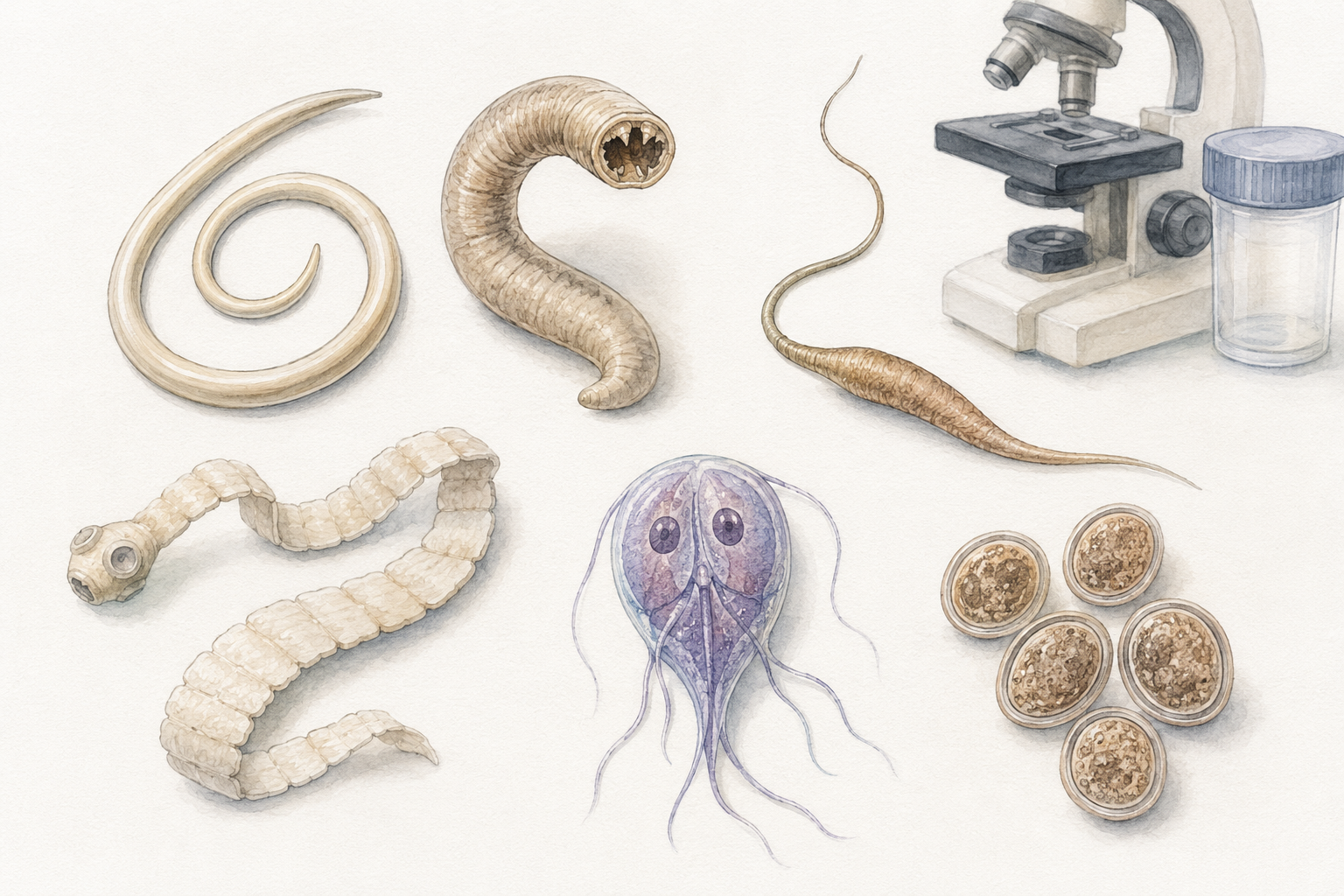
Roundworms, hookworms, whipworms, tapeworms, Giardia, coccidia and other intestinal parasites do not all appear on the same test or respond to the same medicine.
IN THIS GUIDEHelminths have different routes and risksMicroscopic organisms require their own planOne sample and one method cannot detect everythingNormal stool does not rule out infectionReduce exposure without trying to sterilize lifeMatch the medication to the confirmed or likely organismYoung and small animals can deteriorate quicklyTrusted sources
WORMS ARE ANIMALS · PROTOZOA ARE SINGLE-CELLED
The category determines the test, treatment and household plan.
Bring a fresh stool sample when requested and tell the veterinary team about diarrhea, travel, hunting, fleas, raw food, boarding, new animals and human illness. Even normal-looking stool can contain parasite stages.
Flotationlooks for eggs or oocystsAntigendetects parasite proteinsPCRdetects genetic material
01 · COMMON WORMS
Helminths have different routes and risks
| Group | Examples | Key point |
|---|---|---|
| Roundworms | Toxocara canis, Toxocara cati, Toxascaris leonina | Young animals are commonly exposed; some larvae can migrate in people. |
| Hookworms | Ancylostoma and Uncinaria species | Feed on blood or damage intestine; can cause anemia and some infect human skin. |
| Whipworms | Trichuris vulpis in dogs | Eggs persist in soil; shedding may be intermittent and infection can cause large-bowel diarrhea. |
| Tapeworms | Dipylidium, Taenia, Echinococcus species | Dipylidium requires ingestion of an infected flea; other species involve prey or raw tissues. |
| Other worms | Strongyloides, Physaloptera and regional parasites | Exposure and geography guide specialized testing. |
Important: Visible rice-like segments strongly suggest a tapeworm, but routine fecal flotation may miss Dipylidium. Save a photograph or specimen.
02 · COMMON PROTOZOA
Microscopic organisms require their own plan
| Organism | Common pattern | Testing caution |
|---|---|---|
| Giardia duodenalis | Soft stool, diarrhea or no signs; spread through fecal contamination | Cysts may shed intermittently; antigen or PCR may supplement microscopy |
| Cystoisospora (coccidia) | Especially important in puppies, kittens, crowded settings and stress | Species are generally host-adapted; oocysts mature in the environment |
| Tritrichomonas foetus | Chronic large-bowel diarrhea, particularly in young cats from multi-cat settings | Requires targeted PCR or specialized testing |
| Cryptosporidium species | May cause diarrhea, especially in vulnerable hosts | Zoonotic potential and species differ; interpretation needs clinical context |
| Toxoplasma gondii | Cats are definitive hosts; infection biology differs from routine diarrhea parasites | Human pregnancy and immune-suppression questions belong with healthcare professionals |
Important: A positive molecular test does not always prove the organism is the sole cause of signs; results must be interpreted with the animal’s history and examination.
03 · WHY TESTS DISAGREE
One sample and one method cannot detect everything
- Parasites may be immature, single-sex or shedding intermittently.
- Fecal flotation identifies many eggs and oocysts but not every organism equally.
- Antigen tests can detect certain infections when eggs are scarce.
- Polymerase chain reaction (PCR) detects genetic material and may identify organisms missed by microscopy.
- Repeat or combined testing may be appropriate when risk or symptoms remain high.
Important: A negative fecal test means the tested sample was negative by that method; it does not certify that every parasite is absent.
04 · SIGNS & CONSEQUENCES
Normal stool does not rule out infection
- Diarrhea, mucus, blood, vomiting or poor appetite
- Pot-bellied appearance, poor growth or weight loss
- Pale gums, weakness or rapid breathing from hookworm-associated blood loss
- Scooting or visible tapeworm segments
- No visible signs while eggs or cysts contaminate the environment
05 · PREVENTION & HOUSEHOLD HYGIENE
Reduce exposure without trying to sterilize life
- Use year-round broad-spectrum prevention selected for the pet and regional risks.
- Remove feces promptly from yards, litter boxes and public spaces.
- Prevent hunting, scavenging and access to carcasses or raw animal tissues.
- Control fleas to interrupt Dipylidium tapeworm transmission.
- Wash hands after handling animals, feces, soil or litter; supervise children and protect immunocompromised people.
Important: Environmental disinfectants do not reliably destroy every egg, oocyst or cyst. Mechanical removal, drying, heat where safe and exposure prevention are often central.
06 · TREATMENT & RECHECKS
Match the medication to the confirmed or likely organism
- Use the exact dose and schedule prescribed for that animal.
- Treat contact animals only when the veterinary plan indicates it.
- Complete environmental and flea control at the same time when relevant.
- Return for recommended repeat testing; reinfection and treatment failure are different problems.
- Never use livestock dewormers or human medication by guesswork.
07 · WHEN TO CALL
Young and small animals can deteriorate quickly
- Pale gums, collapse, weakness or rapid breathing
- Repeated vomiting, inability to keep water down or severe abdominal pain
- Large amounts of blood, black/tarry stool or profuse diarrhea
- A puppy, kitten or medically fragile animal that stops eating
- Dehydration, fever, marked weight loss or multiple household animals affected
Important: For possible human infection, contact a healthcare professional rather than taking veterinary medication.
TRUSTED SOURCES
Sources behind this guide
Companion Animal Parasite CouncilVeterinary guidelines for mites, worms and protozoal parasites ↗Centers for Disease Control and PreventionHealthy Pets, Healthy People zoonotic-disease information ↗Centers for Disease Control and PreventionDog and cat flea-tapeworm transmission and prevention ↗
Content last reviewedAugust 16, 2026Review statusVeterinary-informed; independent veterinarian review not yet completed.
Source links are provided so readers can review the underlying guidance. Publication dates and recommendations can change; confirm individual plans with the treating veterinary team.