POULTRY HEALTH · OWNER GUIDE
Poultry health and husbandry
for the whole flock.
Practical care for chickens, ducks, geese, turkeys, quail and other domestic poultry—from housing and biosecurity to egg-related disease and emergencies.
IN THIS GUIDEPoultry species do not share one care planBuild for dry footing, clean air and natural behaviorKeep disease from entering—or leaving—the flockUse a veterinarian who understands poultry and flock medicineLaying problems can become emergenciesLook at individuals before scattering feedDo not wait for a sick bird to look dramatically illTrusted sources
FLOCK HEALTH STARTS BEFORE ILLNESS
Know what is normal before one bird changes.
Count birds, observe appetite and activity, inspect droppings and eggs, and notice which individuals separate from the flock. Poultry often hide illness until disease is advanced.
Dailyhead count and observationSeparatenew or sick birds safelyReportunusual deaths promptly
01 · KNOW THE BIRD
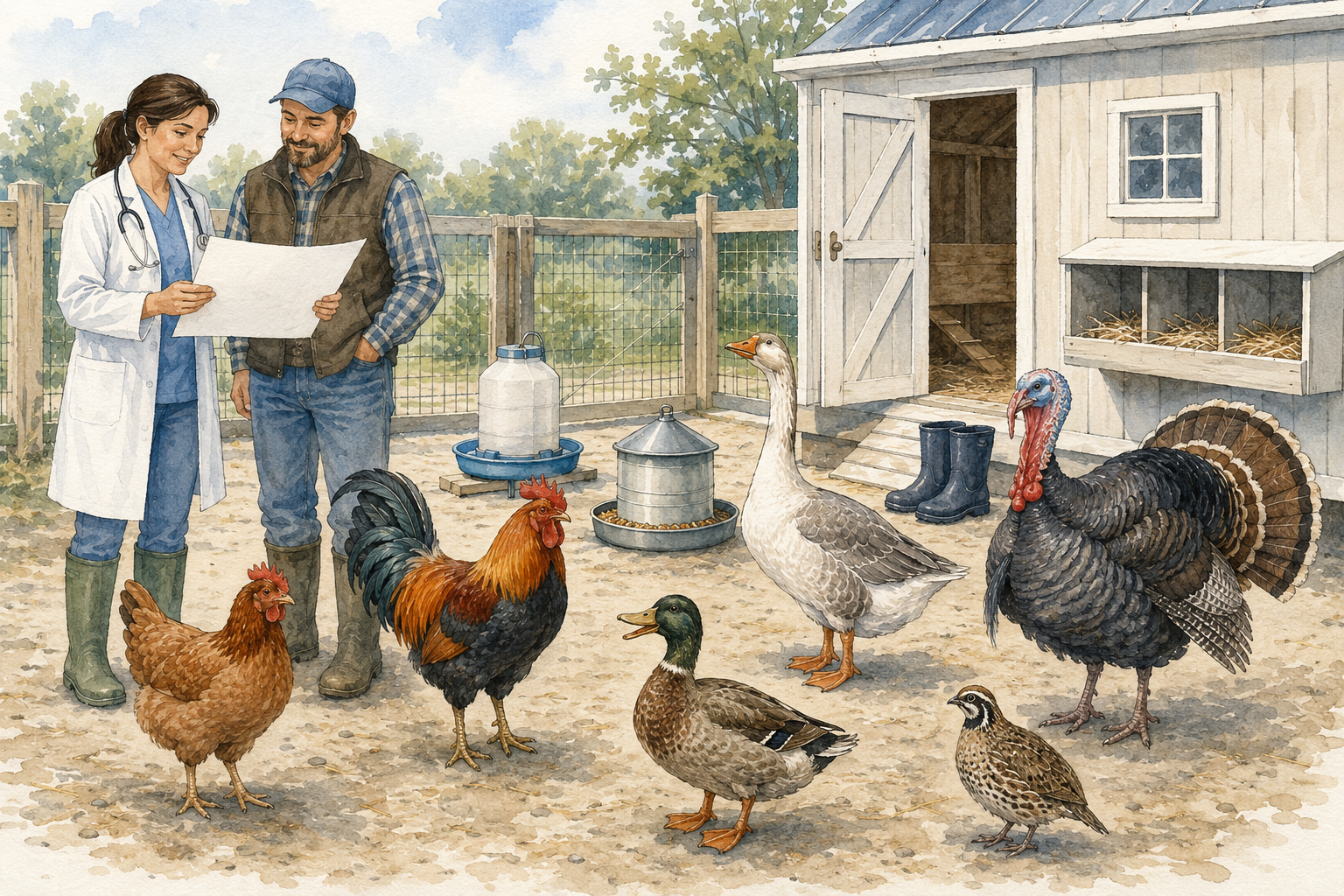
Poultry species do not share one care plan
| Bird | Important differences | Common owner concern |
|---|---|---|
| Chickens | Roosting, dust bathing and flock hierarchy | Reproductive disease, parasites and foot problems |
| Ducks | High water use, wet litter and species-appropriate niacin during growth | Foot injury, contaminated water and reproductive disease |
| Geese | Grazing behavior, larger space needs and seasonal territorial behavior | Foot health, obesity and safe handling |
| Turkeys | Large body size, sensitive growing skeleton and species-specific feed | Lameness, heat stress and respiratory disease |
| Quail | Small size, flight response and secure low-stress housing | Head injury, crowding and rapid deterioration |
Important: Do not use medication, feed, housing density or vaccination advice from one poultry species for another without confirmation.
02 · HOUSING & ENVIRONMENT
Build for dry footing, clean air and natural behavior
- Provide secure predator-proof housing with dry bedding, shade, weather protection and species-appropriate ventilation.
- Prevent ammonia buildup; a strong odor or eye irritation means air and litter management need attention.
- Give chickens suitable roosts and nest boxes; provide waterfowl room to immerse the bill and clean the nostrils without turning all bedding into mud.
- Use nonslip footing and enough feeder, waterer and resting space to limit competition.
- Protect birds from toxic plants, loose hardware, lead, string, stagnant water and unsafe heat sources.
03 · BIOSECURITY
Keep disease from entering—or leaving—the flock
- Quarantine new and returning birds in separate airspace with separate equipment; ask a veterinarian how long is appropriate locally.
- Use dedicated footwear and tools, clean hands, restrict visitors and prevent contact with wild birds and their droppings.
- Do not share crates, egg flats, feeders or equipment without cleaning and disinfection.
- Control rodents and store feed where wildlife cannot contaminate it.
- Isolate illness promptly, but remember exposed flockmates may already be at risk.
Important: Sudden deaths, respiratory disease, neurologic signs or a sharp egg-production drop can require immediate contact with a veterinarian and State or Federal animal-health officials because highly pathogenic avian influenza and other reportable diseases remain important.
04 · ROUTINE PREVENTIVE CARE
Use a veterinarian who understands poultry and flock medicine
- Establish flock goals: companion, exhibition, egg, breeding or food production.
- Discuss local vaccination needs, parasite monitoring and laboratory testing rather than using a universal calendar.
- Check weight or body condition, feet, keel, skin, feathers, eyes, nostrils, mouth and vent routinely.
- Use fecal examination or targeted parasite testing when indicated; deworming without diagnosis can fail and promote resistance.
- Keep purchase, hatch, mortality, treatment, egg and production records.
Important: Medication choices and withdrawal times matter whenever meat or eggs could enter the food chain. Never assume a drug labeled for another animal is legal or safe for poultry.
05 · EGGS & REPRODUCTIVE HEALTH
Laying problems can become emergencies
- Provide a complete layer ration only when appropriate for actively laying birds; growing and nonlaying birds have different requirements.
- Track egg number, shell quality, size and abnormal contents.
- Watch for repeated nesting, straining, tail pumping, a penguin-like stance, abdominal enlargement or reduced droppings.
- Chronic laying can contribute to calcium depletion, reproductive-tract disease and prolapse.
- Do not manipulate the abdomen, pull exposed tissue or attempt to remove an egg at home.
Important: A bird that is straining, weak, unable to perch or passing little stool needs prompt veterinary assessment.
06 · THE DAILY FLOCK CHECK
Look at individuals before scattering feed
- Confirm every bird is present and able to walk normally.
- Watch breathing before birds are excited or handled.
- Check whether each bird approaches feed and water and can compete successfully.
- Notice closed eyes, fluffed posture, drooped wings, pale or blue comb, dirty vent or isolation.
- Inspect water function, litter moisture, predator damage and feed condition.
Important: Photograph or video abnormal movement, breathing, droppings or flock behavior when it is safe; this can help the veterinary team.
07 · WHEN IT IS AN EMERGENCY
Do not wait for a sick bird to look dramatically ill
- Open-mouth breathing, gasping, blue or purple comb, severe bleeding or major trauma
- Collapse, inability to stand, seizure, twisted neck or rapidly progressive weakness
- Repeated straining, prolapse or suspected egg binding
- Sudden death, multiple sick birds or a rapid drop in feed, water or egg production
- Suspected toxin, feed contamination, heat stroke, predator attack or highly pathogenic avian influenza
Important: Call before transporting. Isolate safely, minimize handling and ask whether the clinic can receive poultry. For unusual illness or deaths, follow veterinary and animal-health authority instructions before moving birds or equipment.
TRUSTED SOURCES
Sources behind this guide
Merck Veterinary ManualManagement and nutrition of backyard poultry ↗United States Department of Agriculture Animal and Plant Health Inspection ServiceDefend the Flock biosecurity and disease-reporting resources ↗National Extension Poultry ResourceUniversity Cooperative Extension poultry husbandry and feeding education ↗
Source links are provided so readers can review the underlying guidance. Publication dates and recommendations can change; confirm individual plans with the treating veterinary team.