PARASITE LIBRARY · TICKS
Ticks on dogs and cats
are not all the same.
The tick’s species, life stage, location and attachment time all affect risk. Learn the common North American ticks, safe removal, prevention and when illness needs prompt veterinary attention.
IDENTIFY · REMOVE · RECORD · MONITOR
The tick itself can be useful evidence.
Remove an attached tick promptly and safely, note the date and attachment site, and photograph or save the specimen in a sealed container. A veterinarian can decide whether identification, testing or monitoring is appropriate. Testing the tick itself generally cannot predict whether the animal will become ill.
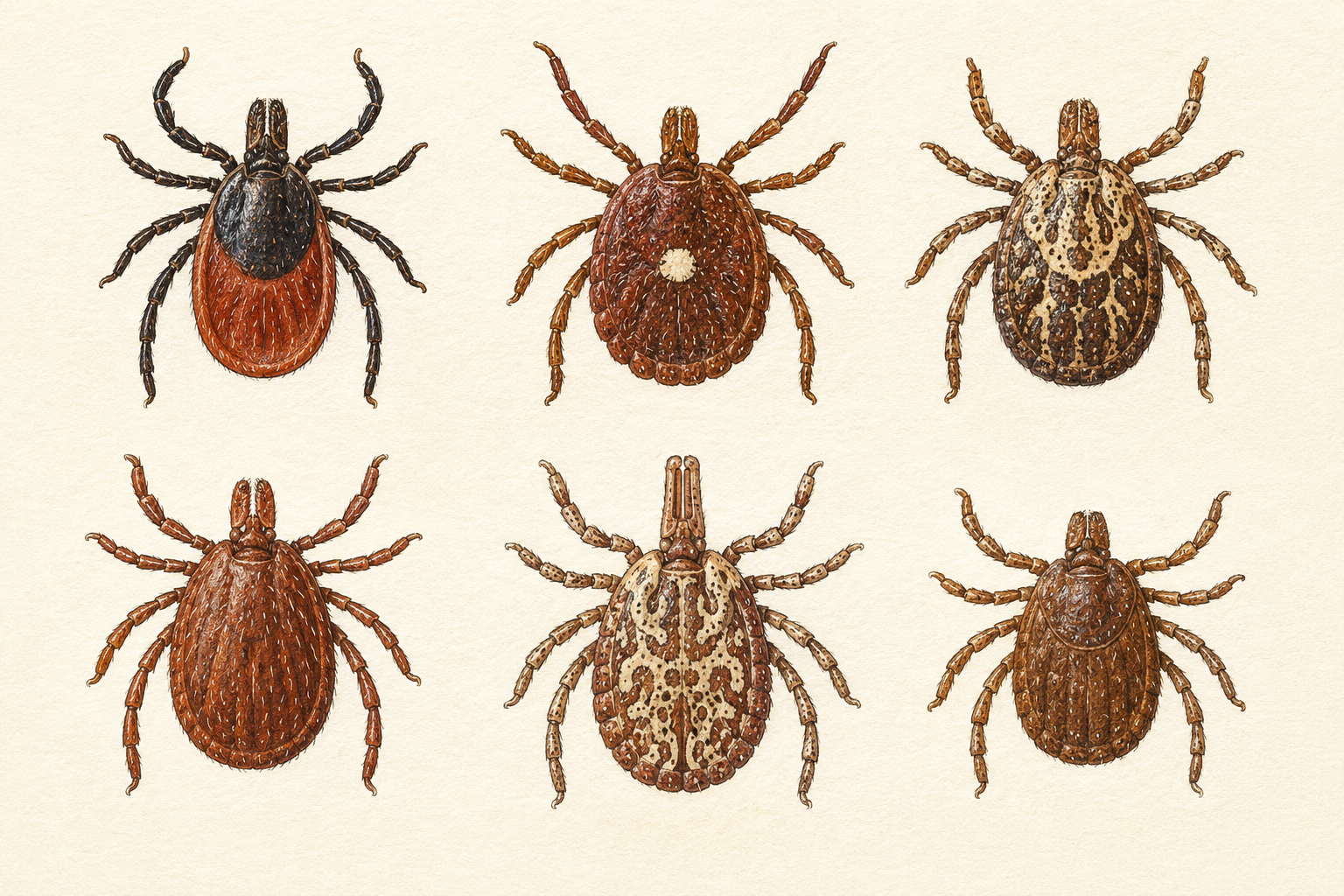
Know the ticks your prevention may need to cover
| Tick | Scientific name | Owner-relevant features |
|---|---|---|
| Black-legged or deer tick | Ixodes scapularis | Small; nymphs can be poppy-seed sized. Associated with Lyme disease, anaplasmosis and babesiosis in parts of its range. |
| Lone star tick | Amblyomma americanum | An aggressive tick; the adult female has a single pale spot. Associated with ehrlichiosis and tularemia, among other concerns. |
| American dog tick | Dermacentor variabilis | An ornate brown-and-cream tick that often uses grassy edges. Associated with Rocky Mountain spotted fever and tularemia. |
| Brown dog tick | Rhipicephalus sanguineus species group | Can complete its life cycle indoors and become established in homes or kennels. Associated with ehrlichiosis, babesiosis and other infections. |
| Gulf Coast tick | Amblyomma maculatum | An ornate tick expanding beyond Gulf and Atlantic coastal areas. Important in American canine hepatozoonosis when a dog swallows an infected tick. |
| Asian longhorned tick | Haemaphysalis longicornis | An invasive tick able to reproduce without mating; heavy burdens can affect animals. Distribution and veterinary importance continue to be monitored. |
A tick bite does not automatically mean infection
- Not every tick carries a pathogen, and transmission timing differs among organisms.
- A negative blood test immediately after exposure may be too early; the veterinary team may recommend a later test based on the organism and clinical signs.
- Positive antibody results can reflect exposure rather than active illness and must be interpreted with examination findings, blood counts, urine testing or other diagnostics.
- Cats can acquire tick-borne disease too, although disease patterns and available tests differ from dogs.
- Tick paralysis is caused by toxin from certain attached ticks and can progress rapidly even without an infectious disease.
Pull steadily—do not burn, twist or smother the tick
- Use clean fine-tipped tweezers or a purpose-made tick-removal tool.
- Grasp the tick as close to the skin as possible without squeezing its swollen body.
- Pull upward with slow, steady pressure until it releases.
- Clean the skin and your hands, then record the date and body location.
- Place the tick in a sealed container or clear bag if identification may be useful.
Feel slowly from nose to tail after outdoor exposure
- Check around eyelids, lips, chin and ears—including under collars and harnesses.
- Feel the neck, armpits, groin, belly, tail base and between every toe.
- Use good light and part long or dense hair down to the skin.
- Check indoor pets too: ticks can enter on people, other animals and belongings.
- Inspect yourself after removal and follow human tick-bite guidance from a healthcare professional or public-health agency.
Match the product to the species—and the tick
- Use the Preventative Comparison to review the exact tick species listed for each product.
- Confirm the animal species, minimum age, current weight, dose interval and neurologic history with a veterinarian.
- Never use a dog-only permethrin product on a cat; even contact with a recently treated dog can be dangerous until the label says contact is safe.
- Give or apply doses on schedule. Do not stack products or repeat a dose early after finding a tick without veterinary direction.
- Reduce brush and leaf litter near high-use areas, discourage wildlife congregation and keep resting areas clean—while recognizing that landscaping alone cannot eliminate risk.
Do not wait for a scheduled visit when serious signs appear
- Weakness, stumbling, inability to stand, facial weakness or trouble swallowing
- Pale gums, collapse, difficult breathing or profound lethargy
- Fever, painful joints, shifting-leg lameness or sudden reluctance to move
- Unexplained bruising, pinpoint red spots, nosebleeds, dark urine or yellow gums
- Repeated vomiting, loss of appetite or rapidly worsening illness after tick exposure
- Drooling, tremors, seizure or severe weakness after a parasite-control product
TRUSTED SOURCES
Sources behind this guide
Source links are provided so readers can review the underlying guidance. Publication dates and recommendations can change; confirm individual plans with the treating veterinary team.