TURTLES & TORTOISES · SPECIES GUIDE
Turtle & tortoise care
must plan for decades.
Aquatic filtration, terrestrial housing, ultraviolet light, nutrition, brumation, shell health and emergency signs.
IN THIS GUIDEAquatic, semi-terrestrial and terrestrial are not interchangeableBuild for the adult animalDiet changes by species and ageThe shell is living tissueDormancy must never be improvisedSeek reptile-experienced careTrusted sources
SPECIES PROFILE
Longevity and adult size make acquisition a lifetime decision.
Common companions include sliders, painted and musk turtles, box turtles and Russian, Greek, Hermann's and sulcata tortoises. Laws may restrict native species and red-eared sliders.
Decadesexpected commitmentUltraviolet-BUVB plus species-appropriate heatAdultsize determines the habitat
01 · WHICH TYPE?
Aquatic, semi-terrestrial and terrestrial are not interchangeable
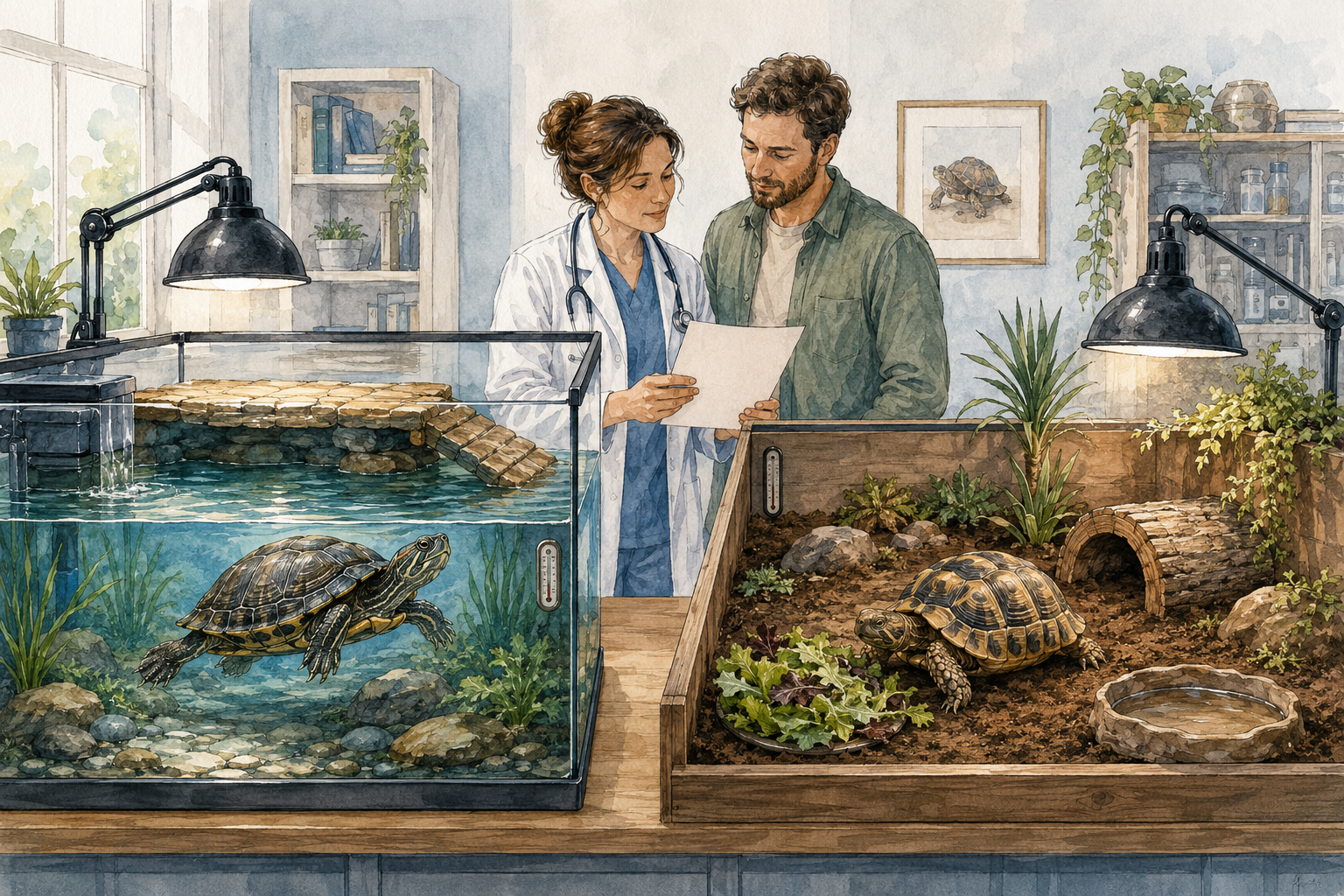
- Aquatic turtles need deep clean water, basking access and powerful filtration.
- Box turtles need land, humidity gradients, soaking and secure outdoor or large indoor space.
- Mediterranean tortoises need herbivorous diets and climate-appropriate housing.
- Sulcatas become extremely large, powerful diggers and require major lifelong infrastructure.
- Confirm scientific species and legal source.
02 · HABITAT
Build for the adult animal
- Provide measured basking temperature, cool areas and appropriate ultraviolet B.
- For aquatic species, test water quality and match depth, current and temperature.
- Use stable ramps and basking platforms that allow complete drying.
- Provide safe substrate, hides, shade and escape-proof fencing.
- Protect outdoor animals from predators, toxic plants and temperature extremes.
03 · NUTRITION
Diet changes by species and age
- Confirm herbivore, omnivore or carnivore proportions.
- Use varied veterinarian-approved plants for tortoises rather than fruit-heavy feeding.
- Aquatic turtle diets may include formulated foods and species-appropriate animal and plant items.
- Provide calcium appropriately with correct ultraviolet exposure.
- Track growth, weight, shell shape and food response.
04 · SHELL, BEAK & FEET
The shell is living tissue
- Inspect for soft areas, ulcers, odor, pits, cracks or color change.
- Do not paint, oil or seal the shell.
- Overgrown beak or nails may reflect diet and habitat as well as need for care.
- Shell pyramiding is influenced by species, growth, nutrition, hydration and environment.
- Traumatic shell injury requires prompt veterinary treatment.
05 · SEASON & BRUMATION
Dormancy must never be improvised
- Identify whether the species naturally brumates.
- Do not cool an underweight, ill or unexamined animal.
- Outdoor animals need secure climate-appropriate shelters and monitoring.
- Record weight and activity through seasonal change.
- Use veterinarian-guided plans for any intentional brumation.
06 · URGENT SIGNS
Seek reptile-experienced care
- Open-mouth breathing, nasal bubbles or severe effort
- Shell fracture, bite, burn or uncontrolled bleeding
- Swollen closed eyes, inability to swim or abnormal floating
- Prolapse, egg-laying difficulty or severe straining
- Marked weakness, refusal of food with weight loss or inability to retract normally
TRUSTED SOURCES
Sources behind this guide
Merck Veterinary ManualReptile management and husbandry ↗Association of Reptile and Amphibian VeterinariansOwner resources and veterinarian directory ↗
Source links are provided so readers can review the underlying guidance. Publication dates and recommendations can change; confirm individual plans with the treating veterinary team.